Most people keep their car’s oil change sticker on the windshield and call it a day. But a complete maintenance history is one of the most valuable assets you own as a car owner — and one of the easiest to lose.
Whether you’re trying to sell your car, make a warranty claim, or simply stay ahead of expensive repairs, your service records are the proof that backs you up. Here’s why they matter more than most people realize, and what you should actually be tracking.
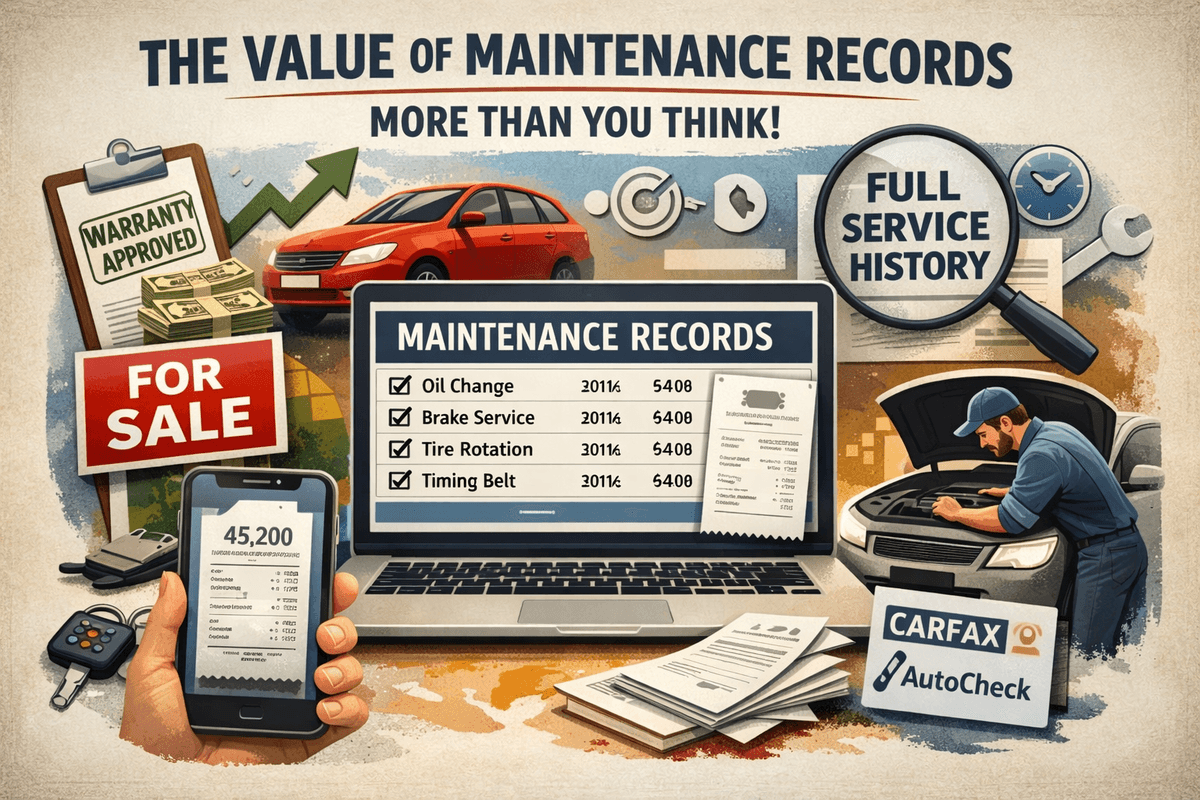
Service Records and Resale Value
When you sell a car privately, the buyer is making a bet. They’re betting that the car was maintained, that nothing major was neglected, and that the price reflects the vehicle’s actual condition. Your service records are the evidence that reduces their risk — and that translates directly into money.
Industry data consistently shows that cars with documented service histories sell for significantly more than comparable vehicles without records. For a well-maintained car in the $15,000–$30,000 range, having organized service records can add $1,000 to $3,000 to the sale price. For luxury vehicles, the premium can be even higher.
It’s not just about the sale price, either. Cars with complete records sell faster. Buyers browsing listings will skip a car with “maintenance records not available” in favor of one with “full service history, all records included.” You’re not just getting more money — you’re getting it sooner.
Warranty Protection
Modern car warranties are generous — many manufacturers offer bumper-to-bumper coverage for 3 years or 36,000 miles, and powertrain coverage for 5 years or 60,000 miles. But warranties come with conditions, and the most important one is proof of maintenance.
If your transmission fails at 45,000 miles and you can’t show that you changed the transmission fluid at the manufacturer’s recommended interval, the dealer has grounds to deny the claim. It doesn’t matter that you actually did the work — without documentation, it didn’t happen.
This is especially important for:
- Oil changes: The most basic maintenance item, and the first thing a dealer checks when evaluating a warranty claim.
- Timing belt/chain service: Skipping this can cause catastrophic engine damage, and it’s one of the most expensive warranty claims.
- Coolant flushes and brake fluid changes: Often overlooked, but required by most maintenance schedules.
Keep every receipt. If you do your own oil changes, keep the receipt for the oil and filter, and write down the date and mileage. A handwritten log is better than nothing.
What to Keep
Not all service records are equal. Here’s a prioritized list:
Must Keep (entire ownership period)
- Oil changes — date, mileage, oil type, who performed the service
- Tire rotations and replacements — date, mileage, tire brand/model
- Brake work — pads, rotors, fluid flushes
- Major services — timing belt, transmission service, coolant flush
- Recall work — the recall notice and the completion confirmation
- Warranty repairs — what was fixed, under what warranty, and any case numbers
- State inspections/emissions tests — pass/fail and any required repairs
Good to Keep (at least 2 years)
- Minor repairs — wiper blades, bulbs, cabin air filters
- Diagnostic reports — especially if a check engine light was investigated
- Alignment records — especially after hitting a pothole or curb
Keep Forever
- Purchase documents — bill of sale, title, registration
- Accident/insurance claim records — even if repaired, the history matters for disclosure
Why a Glovebox Folder Isn’t Enough
The glovebox approach has three problems:
- It’s a single point of failure. If the car is stolen, totaled, or traded in and you forget to grab the folder, everything is gone.
- It’s not searchable. When you need to know when you last replaced the brakes, you’re flipping through a stack of crumpled receipts.
- It doesn’t transfer well. A buyer wants to see a clear, chronological history — not a pile of faded thermal paper.
Digital records solve all three problems. A photo of each receipt, stored with the date and mileage, gives you a searchable, shareable, theft-proof record that lives beyond the car itself.
How to Backfill Lost Records
If you’ve owned your car for years and have little to show for it, don’t panic. You can reconstruct a surprising amount:
- Contact your dealer. Dealerships keep detailed records of every service performed on your VIN. Call the service department and ask for a printout of your vehicle’s service history. Most will provide it for free.
- Check your credit card and bank statements. Search for transactions at auto shops, dealerships, and parts stores. This gives you dates and amounts, which you can match to likely services.
- Request records from independent shops. Many shops keep customer histories in their system, even years later. A quick phone call can recover records you thought were gone.
- Check your email. If you ever received digital receipts from shops like Jiffy Lube, Valvoline, Firestone, or dealerships, search your inbox.
- Use the CARFAX or AutoCheck report. These services aggregate data from shops, dealers, and state agencies. Running a report on your own car can reveal service records you didn’t know existed.
It takes an afternoon, but the result — a complete service timeline — is worth it, both for your own planning and for eventual resale.
Dossiq builds your service history automatically
Snap a photo of any service receipt or forward a digital invoice. Dossiq extracts the date, mileage, services performed, parts used, and cost — then links it to the right vehicle in your garage. Your complete maintenance timeline builds itself, one receipt at a time.
Building the Habit
The best system is the one you actually use. Here’s what works:
- Capture immediately. When you pick up your car from the shop, take a photo of the receipt before it goes in the glovebox. One photo, five seconds.
- Include the mileage. Most receipts have it, but if yours doesn’t, write it on the receipt before you photograph it.
- Forward digital receipts. If the shop emails you a receipt or invoice, forward it to your document system immediately. Don’t let it get buried in your inbox.
- Review annually. Once a year, look at your service timeline. Are there gaps? Is anything overdue? This 10-minute review can prevent a $3,000 repair.
Your car is likely the second most expensive thing you own. Treating its documentation with the same care you’d give your mortgage paperwork isn’t overkill — it’s common sense.
Your car deserves a paper trail
Upload service receipts and Dossiq automatically builds a complete maintenance timeline for every vehicle you own.
Start free trial →